Why Field Spraying Drones Are Changing the Way UK Farmers Work
@zk79qk7pee
A Different Kind of Sprayer
I spent a wet Tuesday last spring walking the headlands of a wheat field in Cambridgeshire, watching a neighbour's tractor bog down in the same corner it always does. The crop was too tall to drive through without flattening it, and the sprayer was stuck waiting for a dry spell that wasn't coming. That afternoon, I called a local contractor who runs a DJI Agras. By Friday, the same field had been treated, and I had walked the whole thing without a single wheel mark.
That experience is becoming more common across UK agriculture. Field spraying drones are no longer a novelty or a gadget for tech enthusiasts. They are a practical tool for getting crop protection products exactly where they need to be, often faster and with less damage to the soil than conventional equipment. The shift is not about replacing tractors entirely. It is about having the right tool for the job, especially when the ground is too wet, the crop is too tall, or the patch of weeds is too localised to justify a full pass.
What Makes a Spray Drone Different
A spray drone is not just a camera drone with a tank bolted on. The DJI Agras series, which dominates much of the market, is built for agricultural work. It has a proper pump, a set of nozzles, and a boom that folds out to give a useful swath width. The latest models can carry ten, twenty, or even thirty litres of liquid, and they fly low over the canopy to deliver droplets with precision. The rotors create a downward airflow that helps push the spray into the crop, which is something a fixed-wing aircraft cannot do.
Battery life is still the limiting factor. A typical flight might last ten to fifteen minutes under load, and then you need to swap batteries and refill the tank. That sounds short, but the work rate is higher than you might think. A single operator can cover several hectares in an hour, depending on the field shape and the amount of obstructions. The real advantage is not speed in a straight line. It is the ability to work in conditions that stop ground rigs completely.
Variable rate application is where these machines start to earn their keep. Instead of treating a whole field at one rate, the drone can adjust the output on the fly, based on a prescription map created from field mapping. If a disease hotspot is in one corner, that area gets a full dose. The rest of the field gets a lighter pass. That saves money on agrochemicals and reduces the environmental load, which is a growing concern for farmers and regulators alike.
The Regulation Reality in the UK
Flying a spray drone in the UK is not as simple as buying one and taking it to the field. The Civil Aviation Authority (CAA) has specific rules for agricultural drone operations. You need permission for aerial application, and that is not a rubber-stamp process. The CAA wants to see that you understand the risks, that you have trained operators, and that you are not going to drift over people or property.
That is why most farmers do not buy their own spray drone. They hire a contractor who already has the CAA permission, the insurance, and the experience. A good contractor will also bring farm management software to the table, so the flight data, the application maps, and the records all feed into your existing system. That is valuable for compliance, but it is also useful for planning next season.
Drone regulations in the UK are still evolving, and the rules for flying beyond visual line of sight are tighter than many people expect. For now, most spray operations are done within sight of the operator, which is fine for a single field but not for a thousand-acre estate. The technology is ready for more, but the legal framework is catching up at its own pace.
Where Spray Drones Shine
I have seen three situations where field spraying drones genuinely outperform ground equipment. The first is on wet or fragile soils. If you have heavy clay that cannot take a tractor in February, a drone can still get the treatment on without compaction. The second is in high-value crops like fruit or vines, where the canopy is narrow and the spray needs to reach the underside of leaves. The third is for spot treatment. Instead of spraying a whole field for a few thistles, you fly the drone to the patches and treat only those.
Precision agriculture is built on this kind of targeted thinking. The drone is not just a machine. It is a data collection tool and an application tool in one. The field mapping that you do for a drone flight also gives you information about crop health, drainage issues, and variability across the field. That information feeds into decisions long after the spray job is done.
There are trade-offs, of course. The upfront cost of a good agricultural drone is significant, and the learning curve is real. You need to understand nozzle selection, droplet size, drift management, and weather. A light wind that would not bother a tractor can ground a drone. And the battery life means you need to plan your day around charging, not just flying.
The Broader Picture
Yamaha Motor has been building agricultural drones for decades, and their early work in rice paddies proved that the concept was sound. But it is the modern electric platforms, led by DJI Agras, that have brought the price down and the capability up. The result is that drone spraying is now accessible to a contractor who serves a dozen farms, not just a multinational operation.
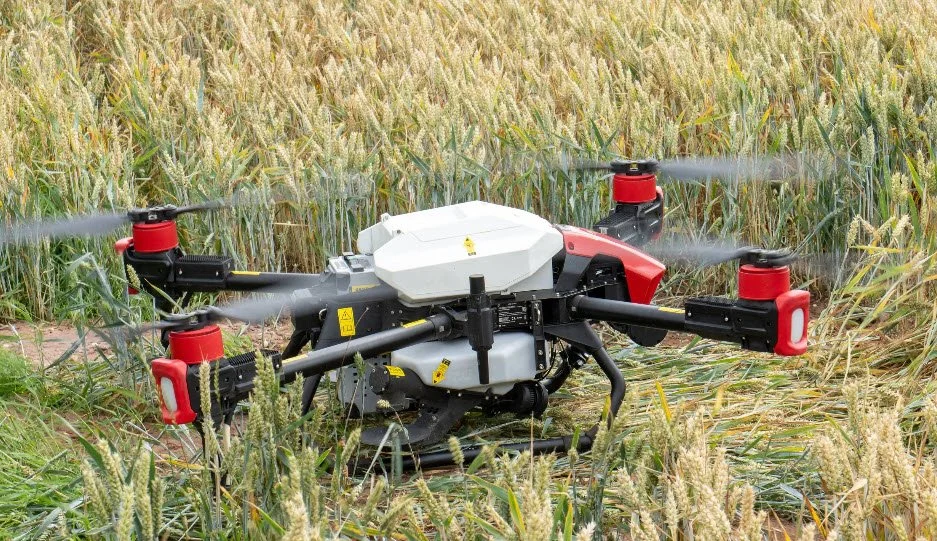
For UK agriculture, the appeal is practical. Labour is hard to find, and the people who do the spraying are often the same people who do everything else. A drone can take over one job and free up a tractor driver for something more productive. It also reduces the risk of operator exposure to pesticides, which is a serious health consideration. The person on the ground refills the tank, but they are not walking through the spray cloud.
Crop protection is becoming more targeted, and that is good for everyone. The public is concerned about pesticide application, and farmers are concerned about resistance. Drone spraying, combined with GPS guidance and variable rate application, allows for lower overall volumes of agrochemicals while maintaining control. It is not a silver bullet, but it is a step in the right direction.
What to Look For in a Spray Drone Service
If you are thinking about using field spraying drones on your farm, the first thing to check is the contractor's credentials. Ask for their CAA permission and their insurance certificates. Then ask about their experience with your crop type and your local conditions. A drone pilot who works on arable farms in Lincolnshire may not be the right fit for a vineyard in Sussex.
Ask about the equipment, too. Is it a DJI Agras or something else? What is the swath width? How do they handle battery swaps in the field? How many hectares can they cover in a day? And crucially, what does the data look like when they are done? A good service will give you an application map that you can keep for your records.
There is also the question of cost. Drone spraying is not cheap per hectare when compared to a large self-propelled sprayer on a big field. But the value comes from the flexibility and the reduced soil damage. On a small field, or on a field that is awkward to access, the drone can actually be more economical. It is worth doing your own sums for your own fields.
A Practical Future
I am not suggesting that drones will replace all ground sprayers. There are plenty of jobs where a 24-metre boom and a 3,000-litre tank are the right tool. But the next generation of spray drones is closing the gap. Battery technology is improving, and some models are already using hybrid systems for longer endurance. The software is getting smarter, and the integration with farm management software is becoming seamless.
The key is to think about the problem you are trying to solve. If you have a field that is too wet to travel, a drone can get the treatment on. If you have a patch of blackgrass that you want to stop from spreading, a drone can hit it before it seeds. If you want to reduce your pesticide application and prove it to a customer, a drone gives you the data to do that.
I have been farming for long enough to be sceptical of new technology. I watched the first GPS guidance systems and thought they were a gimmick. Now I would not be without them. Drone spraying feels the same. The first time I saw a drone working, it seemed like a toy. The first time it saved me from a wet week and a missed spray window, it became a tool.
The next time you are stood at the edge of a field, looking at a crop that needs treating and a sky that is threatening rain, it is worth thinking about what a drone could do. Not as a replacement for everything, but as another option in the box. The technology is here, the regulations are workable, and the results speak for themselves. The question is not whether field spraying drones are the future. It is how quickly the rest of us catch up.